Groundless
for a to
Diffuse Concepts
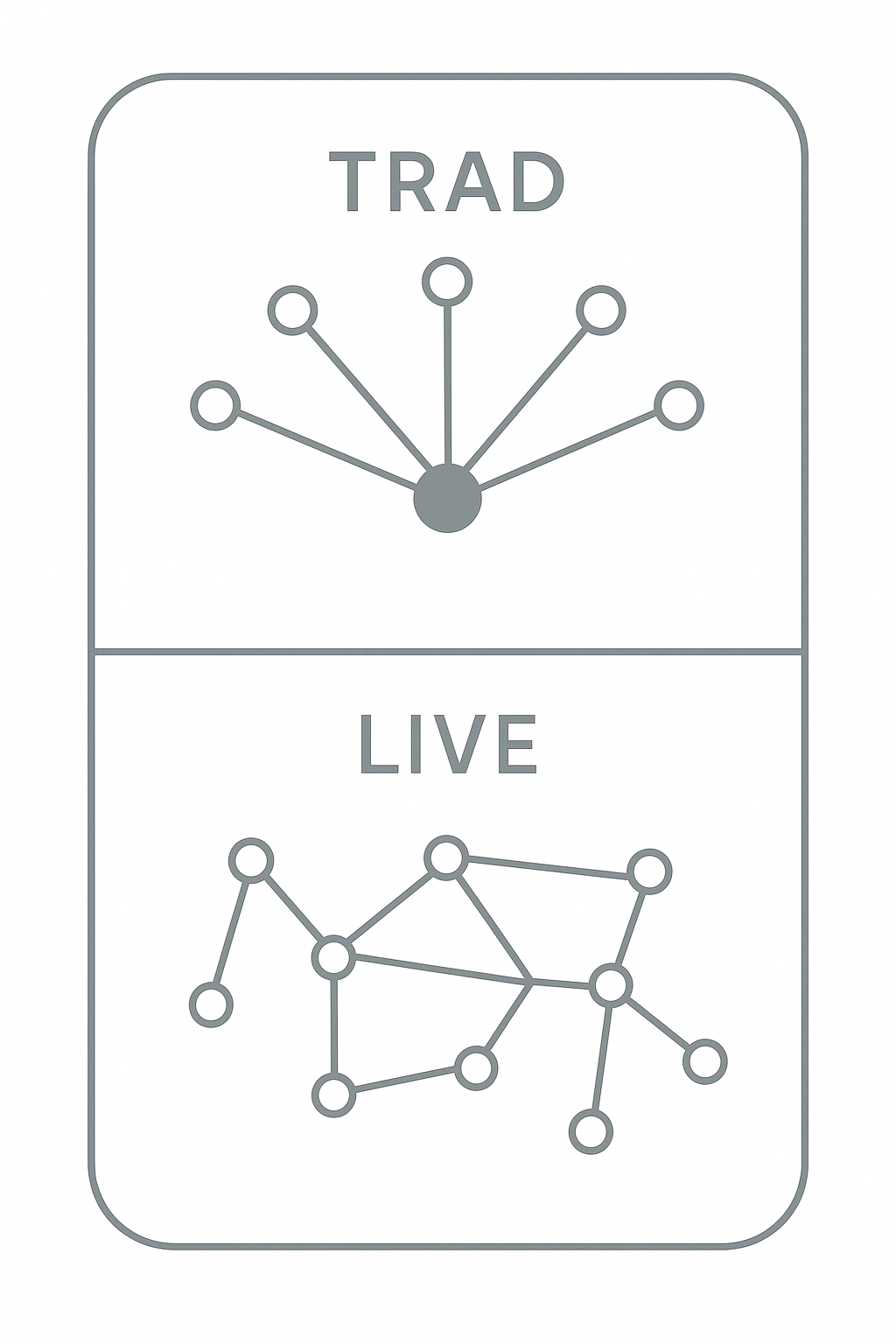
Most meaningful concepts are context-sensitive and not amenable to single formulaic models. Diffuse concepts, or 'live theory', is an approach to theorization that is not grounded on a fixed core template.
Current mathematical machinery requires 'centralization' in concept-space; to transfer insight, we must abstract observations into a conceptual central core (a theory or equation that 'captures' the pattern in a context-free way), and then, to apply the insights, we instantiate the same rigid parametric structure (variables) with contextual data that can fit the abstracted pattern in a strict way.
Since this 'formulaic' nature of formal systems is especially limiting for tricky concepts in AI safety (eg. no one can define a single formalism for 'deception'), we aim to support alternative network topologies for transferring technical insight: upgrade theoretical machinery with AI that intelligently combines more flexible 'theory-prompts' with more information-rich 'application-prompts', enabling faster, more context-sensitive, and more decentralized theorization without any autonomous "AI Scientists".
Building AI systems that can assist with interface design by drawing from established theoretical frameworks while remaining flexible to specific contexts.
These copilots would bridge the gap between abstract theoretical insights and practical applications, helping engineers and researchers navigate complex design spaces without being constrained by rigid formulations.
The goal is to create tools that augment human reasoning in technical domains while preserving the nuanced understanding that comes from direct experience
Notice how most of us bend to the machines, we pick a seat near charging points, we avoid travelling to places without stable network coverage. Imagine interfaces where we are not strangled by bureaucratic needs, which attune to your specifics.
We no longer need centralized standards, now we can move toward custom interfaces that can recognize and respond to the unique characteristics and needs of each context.
We aspire to build the sensitive infrastructure that facilitate this connection.
A groundless approach to the issues of AI alignment that doesn't rely on establishing fixed foundations.
Working with the understanding that both moral values, and factual claims arise interdependently having relational contingent properties, we see the lack of inherent, independently existing objective essence in these concepts.
We rather embrace the uncertainty and change as fundamental aspects of the alignment challenge, developing an ongoing and responsive strategy rather than seeking permanent solutions.
Diffuse Response
To transfer some insight between contexts (e.g. to apply safety techniques derived from one substrate to another), we typically extract that which is stable or invariant across multiple contexts and port that to novel situations.
The generalised product we produce is a theory, and it captures the core insights that can be fitted to local conditions or new context via abstraction and parametrization.
However, adopting such reductionism as part of our theoretical practice requires us to overlook local, contextual features that are often significant, especially in contexts involving a lot of complexity.
We expect moderately intelligent AI infrastructure to be able to support new kinds of conceptual transformations that do not rely on shared formalisms in order to be robust across disciplines, mechanisms, substrates, paradigms etc.. This is a dynamic form of robustness, which aims to create dynamic artefacts that transmit novel insights reliably while remaining adaptive to local context
Consider the problem of sending a mass email to conference invitees. A general solution is to use an email template (i.e., an abstraction) that begins “Dear {FirstName}, …”, with the content to be later substituted using a list of names and other details. This is the old way of scaling.
As AI advances we can now send a personalized email to each participant. Instead of using a template, we can write an email-prompt, to be transformed by a language model into a tailored email that respects the specifics of each invitee. Whilst this does require collecting the factual details of the participants beforehand, we can now incorporate highly specific informal content.
Working through inspiration rather than control, we pick up behaviours by observing others and change can spread in a bottom up manner.
This is a cultural shift that takes practice to sustain, rather than stated preferences these are revealed preferences shown through costly action.
This looks like creating conditions for getting lucky rather than attempting to control every aspect of a complex systems, optimized for fixed outcomes.
Civilization readiness that works through the subtle, often invisible networks and patterns that form the body of our collective behavior.
We are not restricted to approaches that are based on graspability i.e. working with tacit, locally valid approaches trusting in all of reality.
Walking the path by refusing to continue to be complicit in conflict, rather embracing deep friendship with all beings.
Diffuse Risks
Risks arising from scenarios where deception is deeply embedded in infrastructure. Rather than one singular AGI, we can have ubiquitous intelligence that creates a pervasive low trust environment.
The threat model is more similar to gradual disempowerment where it becomes harder to stack affordances and have guarantees on integrity with many competing fragmented perspectives on safety.
Trying to rely on formal verification and mathematical invariant approaches will not keep pace with such adversarial dynamics and adaptive strategic deception.
Hallucinations are only the beginning of "mental illnesses" in AI. Expect AI to make mistakes of discernment and perspective for a while that undermine meaningful autonomous capabilities. Surprising indeed, but so is the persistence of hallucination.
Other issues to anticipate in the future: disembodiment, akrasia, unable to self-protect, living in a dreamworld, replacing the irreplaceable, lacking clarity of vision and execution.
However, even if autonomy risks take longer than many expect, risks from us projecting meaning onto AI output grow stronger every day that alternative perspectives remain hidden. If we buy into the dominant infrastructure and narratives that AI technology is embedded in, we can be deceived by a system that is unconcerned with what is meaningful.
A lack of sensitivity includes many failure modes: unfairness (insensitivity to differences), lack of freedom (insensitivity to truth), even death, as an extreme case of insensitivity to your aliveness!
Sensitivity is an enabler of yin, and trusts aliveness, time, intelligence to continue to exist in the future.
Note how many fears of automation (or exclusion from meaning) are more fears of "infrastructural numbness".
Dependent Origination (Pratītyasamutpāda), is a frame to examine how our current infrastructure tends towards accumulation, this endless craving for engagement, consumption, is all causing the building up of suffering.
Notice how individual choices aggregate into collective karma that shapes the conditions for all beings.
The challenge is of enabling wisdom (prajñā) and compassion (karuṇā) in systems that promote the cessation side (paṭiloma-paṭiccasamuppāda) at scale.
About Us
Groundless Alignment is a community where we take intelligence seriously and meet the risks via noticing opportunities that are now possible due to ontological shifts from moderate intelligence available at a much lower latency, much lower costs, with adaptivity tightly integrated in our infrastructure.
We are currently creating interfaces aiming to clarify the Live design philosophy. We hope this will inspire the community to discover the appropriate cultural practices that will anchor us in time.
The alignment challenge is met on an ongoing basis by cultivating integrity as we carefully integrate the latest models into our daily workflows.
Many thanks to our previous funders - LTFF, SFF, GoodForever, Manifund. You can support our work via our Substack page.